 You are here:
Fully Automatic Rivet Nut Gun in Sheet Metal: Thin-Sheet Solutions
Sheet metal fabrication is one of the biggest users of rivet nuts anywhere. Cabinet doors, mounting panels and appliance housings all need a durable internal thread in 1-3 mm sheet so hinges, slides, shelves and accessories can be bolted on later. The fully automatic rivet nut gun was built for exactly that job; here is where it sits in a sheet metal process, and what has to line up around it.
For global buyers the practical questions are documentation, voltage, spare parts and response time - all four are settled in the supply package. The notes below cover fully automatic rivet nut gun work from an export buyer's point of view.
In short, for export buyers, importers and factory groups worldwide: three threading pain points in sheet metal; typical sheet metal parts; process setup points for sheet metal; from hand tools to automation: the fully automatic rivet nut gun upgrade path.
1. Three Threading Pain Points in Sheet Metal
Tapping thin sheet does not hold: in a thin panel the thread is only two or three pitches deep, so it strips as soon as a screw is tightened hard, and the joint never survives repeated disassembly. Weld nuts bring their own defects: spot-welded nuts distort the panel and leave spatter, cold joints and burn-through, and they ruin any finish already applied. The back side is out of reach: there is no room for a hand or a backup tool inside a box section, a square tube or a closed chamber. A rivet nut installs from one side, forms cold and can be fitted after painting, which solves all three problems at once.
2. Typical Sheet Metal Parts
| Segment | Typical parts | Common nut |
|---|---|---|
| Server and telecom cabinets | Door hinges, internal mounting panels, rail fixing | M4-M6 flat or countersunk head, stainless or steel |
| Power distribution and control cabinets | Frame, mounting rails, doors, grounding parts | M5-M8 hexagonal, anti-rotation |
| Appliances and kitchen equipment | Microwave, AC and range hood housings and brackets | M3-M6 flat head, aluminum or steel |
| Aluminum panels and curtain walls | Back-side brackets, stiffener fixing | Aluminum or stainless knurled, to block galvanic corrosion |
| Elevators and display fixtures | Cabin parts, square tube frames, display stands | M4-M8 blind or through-hole |
Where a line is being rebuilt, the machine can be specified around the existing stations.
3. Process Setup Points for Sheet Metal
Rivet nut quality is decided at the cutting and punching stage, not at the gun. First comes the prepared hole: drill to the nut maker's size chart, round holes for cylindrical nuts and hex holes for hexagonal nuts, because an oversize hole leaves the nut loose and an undersize one will not take it. Second, edge distance and hole spacing: leave enough room from bends and panel edges for the nut body to collapse without pushing the edge up. Third, bend tolerance: the two mating faces must sit flat, since pulling a nut down across a wide gap leaves it loose. Fourth, finish sequence: rivet the nuts after painting or powder coating wherever possible so the coating cannot block the thread, and use countersunk nuts on visible faces to keep them flush.
4. From Hand Tools to Automation: The Fully Automatic Rivet Nut Gun Upgrade Path
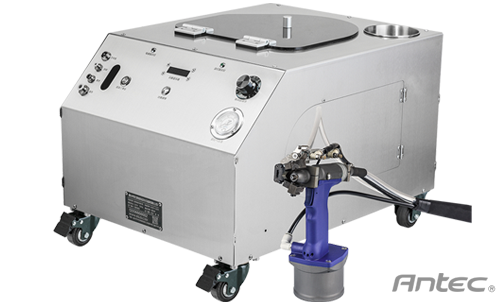
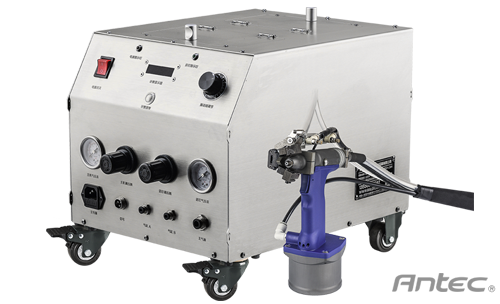
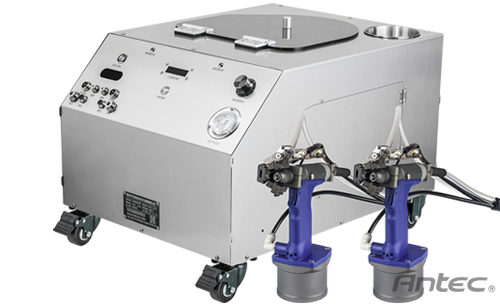
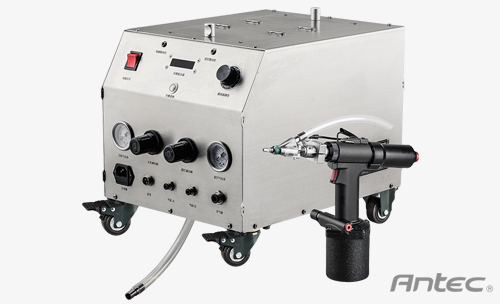
For high-mix, low-volume shops, a pneumatic semi-fully automatic rivet nut gun is flexible and cheap to bring in. Where the hole pattern is fixed and volumes are high, as on door panels and mounting plates, an fully automatic rivet nut gun removes the pick-up, spin-on and spin-off motions, so cycle time and consistency both improve immediately. Cabinet or automotive part lines can go further with a fixed station or a robotic cell. Enclosure and switchgear builders can follow the automotive path in our NEV parts riveting case study, and the equipment comparison is in handheld, fixed, dual-gun and robotic cell options compared.
Voltage, air supply and documentation are checked before dispatch, not after arrival.
Sheet Metal Applications FAQ
Shipping & Warranty Q&A
Yes, small sizes and thin-wall rivet nuts are available, but hole size and pull force have to be tightly controlled. Send a sample of the actual sheet for a trial set so the nut cannot bulge through the face.
Aluminum in contact with steel can corrode galvanically in wet conditions. For curtain walls and outdoor aluminum panels, specify aluminum or stainless nuts and treat the joint accordingly.
Once the old nut is drilled out you generally cannot reuse the same hole. Move over and drill a new hole where the design allows, or repair with an oversize nut, and verify the locating fixture on the first part for critical visible faces.
Yes. The manufacturer serves customers worldwide and will bring a matching model to run your own sheet metal parts, measure cycle time and check the thread pass rate.
Fully Automatic Rivet Nut Gun at a glance: 12,800 N pull force, 80 cycles per minute, standalone units in stock for export, full technical support worldwide.
Send the rivet specification, workpiece and output target - the export team will confirm the model, the in-stock position and the shipping schedule.
One complete unit, shipped and supported worldwide
Tell us the workpiece and the destination port. We will quote the machine, the export packing, the warranty and the technical support in one reply.
5. Four Steps to Automate a Sheet Metal Shop
Step one, baseline: list every product's nut sizes, nut count per part, monthly volume and current riveting headcount, then pick the parts with the most nuts and the highest volume. Step two, trial: have the manufacturer run your real sheet metal parts on an fully automatic rivet nut gun and record time per nut, time per part, thread pass rate and operator feedback. Step three, pilot: put one machine on a single door panel or mounting plate line, run a full month of orders and measure the real change in labor and defects. Step four, rollout: copy the proven cycle times and fixture design to similar stations, and write nut sizes and hole standards into the sheet metal process card so consistency starts at the cutting stage. Cabinet and switchgear builders can read more in automating sheet metal and stainless fabrication.
Start by consolidating nut sizes to fewer M-thread variants, then use a handheld auto-feed gun with fast changeover. A fixed line only pays off on stable, high-volume parts, so you do not have to jump straight to it.
Further reading: rivet nut types and selection chart · through-hole and blind-hole requirements · fully automatic rivet nut gun
 Previous